Educating for Character, Courage and Compassion: The Legacy of Kurt Hahn
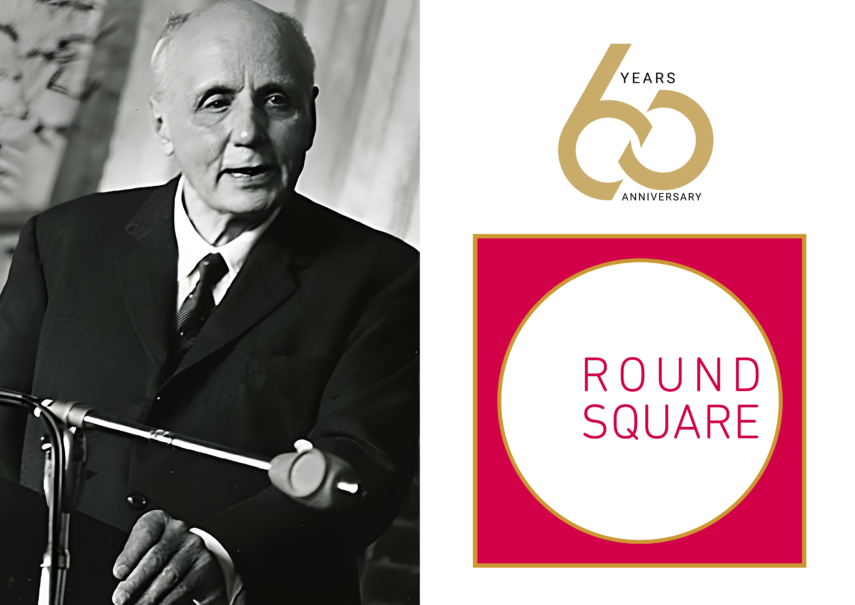
This year is the 60th Anniversary of the founding of the Round Square. This organization, dedicated to experiential learning and to the memory and educational philosophy of Kurt Hahn, now numbers around 280 vibrant schools in 50 countries. The Round Square is a very substantial and significant consortium of schools worldwide, international schools and national schools combined. Therefore, I would like to take this opportunity to reflect on the legacy of Kurt Hahn.
Kurt Hahn was a German-born educator who lived from 1886 to 1974. He was a giant of 20th century international education, widely conceived, and he had a direct hand in the founding of Outward Bound, the United World Colleges, the Duke of Edinburgh’s Award and the Round Square.
The first school that Hahn founded was Schule Schloss Salem, in southern Germany, in 1920. In 1933, he was imprisoned by the Nazis as he had urged his students and young graduates to resist the growing power and reckless cruelty of Hitler. When he was released, he moved to the United Kingdom, where he started Gordonstoun School in Scotland.
At Salem, Hahn developed a succinct set of guidelines for defining his school community. These he called The Seven Laws of Salem. They still exist there, in Hahn’s original writing. I remember the excitement with which I transcribed them into my personal notebook the first time I visited Salem School, many years ago. Here they are:
First Law Give the children opportunities for self-discovery
Second Law Make the children meet with triumph and defeat
Third Law Give the children the opportunity of self-effacement in the common cause
Fourth Law Provide periods of silence
Fifth Law Train the imagination
Sixth Law Make games important but not predominant
Seventh Law Free the sons of the wealthy and powerful from the enervating sense of privilege
Every one of these ‘laws’ both deserves and rewards reflection. And every one still has deep relevance for schooling and schools today, international and national. I want here to say just a little about three of them. I’ll leave the other 4 for you to contemplate on your own, or with friends.
Give the children opportunities for self-discovery
Hahn believed that young children are inherently curious and that, because of this, one crucial component of a progressive education is to allow their tendency to self-discovery to flourish. This injunction is connected to the brief comment in law number five on training the imagination. Self-discovery is the encouragement of a sense of agency that will allow young children to search imaginatively on their own for each one’s special and particular passions. Through this comes the discovery of self, each person’s unique identity. Hahn believed that we should all explore what he called our ‘grand passions’. It was this conviction that gave rise to the Extended Essay, Hahn’s contribution to the IB Diploma Programme.
Give the children the opportunity of self-effacement in the common cause
Hahn understood the value of working in teams, in ways where individual gratification is far less important than bonding collaboratively to ensure effective results in support of unifying causes and worthy projects. This ‘self-effacement’, or modesty, or humility, qualities that are the opposite of rampant individualism, are ones that Hahn believed to be crucial in the development of civil communities, both in schools and elsewhere. We would certainly benefit, in my opinion, from a lot more self-effacement in our contemporary world. There is way too much that draws attention to powerful and diverting characters, usually egotistically, and not nearly sufficient focus on the common causes that build and bind communities.
Provide periods of silence
Close to one hundred years ago, the visionary Hahn could see that modern living was being overrun by noise, and distracting speed. That insight has been made so much more relevant to our lives since the electronic, technological revolution of which so many humans are beneficiaries. How do we find poise, and quiet, in this rush of incessant imagery and surfeit of superficiality? How do we balance the undeniable benefits of information technology and social media and Generative AI with the never-ending demands that these benefits place upon us, and to which it is so easy to become addicted? Reflective periods of silence are vital, and more and more endangered. We do not protect and preserve silence nearly enough in our schools. How often do we free ourselves from our digital devices and sit silently, contemplating or meditating? And how often do we miss opportunities for human contact and conversation because we eat, and meet, while glued to small screens.
Many of Hahn’s most famous utterances, like the 7 Laws of Salem, are deliberately pithy and gnomic. They need to be explicated, as I have attempted to do. Here is a paragraph from Hahn on five challenges facing education, for which he is renowned. In Hahn’s view, expressed many decades ago, these five qualities were under serious threat:
I regard it as the foremost task of education to insure the survival of these qualities: an enterprising curiosity, an undefeatable spirit, tenacity in pursuit, readiness for sensible self denial, and above all, compassion.
I agree with Hahn. In my opinion, these fine qualities should have a substantial place in all schools, and they are still under threat: their survival and nurturing may be even more important now than they were then.
Here are my brief interpretations of only the last two of these qualities. I’ll again leave the others to you, the reader, to ponder:
Readiness for sensible self denial
Self denial is often associated with certain types of religious austerity, and with ascetics who choose to deny themselves the pleasures of a normal life. This is not what Hahn meant. Sensible self denial tells us not always to expect an easy or quick gratification of our wishes. Too often these days we are schooled to expect instant gratification. There are times when we have to struggle to master skills that are tough and demanding, and that require huge and sustained effort to gain, or to perfect. And there are times when we have to wait, and there are many things worth waiting for. There are also times when we need to realize that denying ourselves might mean opening up possibilities and opportunities for others.
And, above all, compassion.
We speak a great deal about compassion in schools. However young or old we are, we all need to learn and to continue learning how to think with our hearts and feel with our brains. Compassionate caring for others is one of the finest qualities of humankind. And it is the foundation stone for that essential human quality, forgiveness, needed now more than ever. We must try to develop, in our schools, cultures of forgiveness. Restorative practices are an essential part of this. Educating for peace remains for many a main thrust of international education. Within our schools and in the ongoing life’s work of our graduates, this necessitates knowing when and how to forgive.
In the schools that Hahn founded, students were trained in compassionate service, frequently through the Rescue Services that were Hahn’s trademark. As he once said: “The passion of rescue reveals the highest dynamic of the human soul”. When I worked at Atlantic College, the first of the now 18 United World Colleges, students were engaged every day in three Rescue Services: Sea Rescue, Cliff Rescue, and Beach Rescue. Over the years, Atlantic College students were credited with saving numerous lives along that dangerous stretch of Bristol Channel coastline which the college fronts.
Rescue does not need to be of the physical kind. If we learn to think and feel about compassion as the tendency, desire, and capability to rescue others who are in distress, of whatever kind, and if we practice that, then we will be growing and enhancing this essential quality in our lives.